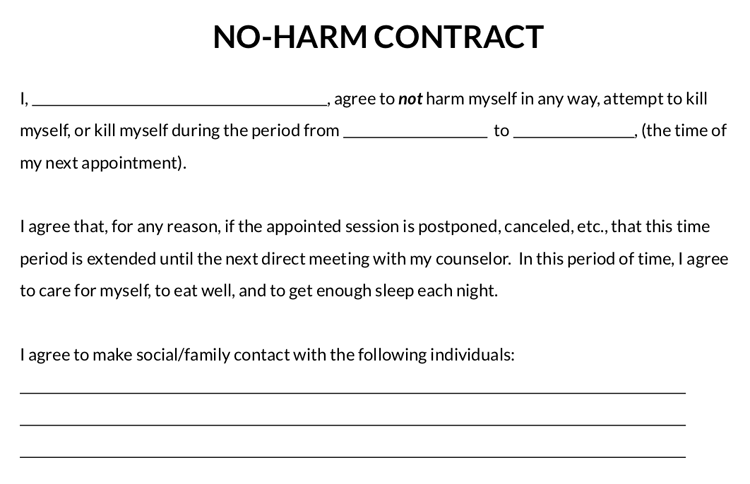
Navigating the complexities of mental health can feel like walking through a thick fog where every step is uncertain and heavy. When someone you care about or a client you are working with is struggling with thoughts of self-harm, finding the right words and the right tools is paramount to ensuring their safety and well-being. This is where a no self harm contract template comes into play as a collaborative framework designed to foster communication and provide a concrete plan of action during the darkest moments. It is less about a formal legal agreement and more about a shared commitment to safety and a roadmap for navigating crises when they inevitably arise.
The concept behind these documents has evolved significantly over the years. Traditionally, they were seen as rigid promises made to a therapist or a loved one, but modern psychology views them as dynamic safety plans. They act as a physical reminder that there are alternatives to self-inflicted pain and that a network of support is always available. By putting these thoughts on paper, the abstract feeling of despair becomes a tangible set of steps that can be managed and overcome with the right resources.
It is important to approach this process with a great deal of empathy and zero judgment. The goal is not to force a signature on a piece of paper, but to open a dialogue that allows the individual to feel heard and supported. When used correctly, these templates provide a sense of agency to the person in distress, reminding them that they have the power to choose safety even when their emotions are telling them otherwise.
Understanding the Role of Safety Planning in Mental Health
To truly understand why people look for these tools, we have to look at the psychological state of a person in crisis. Often, when the urge to self-harm becomes overwhelming, the brain ability to think logically and remember healthy coping mechanisms is significantly impaired. Having a pre-written guide allows the individual to bypass the need for complex decision-making during a high-stress event. It serves as an external memory bank for all the reasons to stay safe and the specific people who are ready to help at a moment’s notice.
The transition from the old-school no-harm contract to a modern safety plan is a vital distinction to make. Critics of the traditional approach argued that it placed too much pressure on the individual and could lead to feelings of guilt if the contract was broken. Modern templates focus instead on harm reduction and proactive strategies. They recognize that the journey to recovery is rarely a straight line and that having a safety net is more effective than just having a rulebook.
Integration is key when implementing these documents into a treatment plan. It should never be the only tool used, but rather one piece of a much larger puzzle that includes professional therapy, medication if necessary, and a strong social support system. When everyone involved is on the same page, the document becomes a powerful symbol of the collective effort to prioritize mental health and physical safety above all else.
Core Elements of a Successful Safety Agreement
A comprehensive no self harm contract template should start by helping the individual identify their specific warning signs. These might be internal thoughts, certain physical sensations like a racing heart, or external situations that tend to trigger the urge to self-harm. By recognizing these signs early, the person can initiate their safety plan before the crisis reaches its peak intensity.
The next section should focus on internal coping strategies. These are things the person can do on their own without needing to contact anyone else immediately. Examples might include deep breathing exercises, physical movement, journaling, or using a specific sensory grounding technique. This part of the plan empowers the individual by reminding them of their own internal resilience and the tools they already possess.
Finally, the plan must include a clear list of social contacts and professional resources. This includes friends or family members who are safe to talk to, as well as 24-hour crisis hotlines and local emergency services. Having these numbers written down in one place removes the barrier of having to search for help when someone is already feeling overwhelmed and exhausted.
How to Effectively Implement a Safety Plan
Introducing the idea of a safety plan requires a delicate touch and a focus on collaboration. It should be presented as a way to work together to ensure safety rather than a top-down instruction. You might start the conversation by saying that you want to make sure there is a solid plan in place for those times when things feel particularly difficult to handle. This helps the individual feel like an active participant in their own recovery process rather than a passive recipient of care.
It is also crucial to remember that a safety plan is a living document. It should not just be filled out once and tucked away in a drawer never to be seen again. Regular check-ins to review and update the plan are essential. As a person grows and learns new coping skills, or as their social circle changes, the template should be adjusted to reflect their current reality. This keeps the plan relevant and ensures it remains an effective tool for long-term safety.
- Identify early warning signs and specific triggers
- List internal coping mechanisms that have worked in the past
- Identify social settings or people that provide a positive distraction
- List family members or friends who can be contacted during a crisis
- Include professional resources like therapists and crisis hotlines
- Define clear steps to make the environment safe by removing harmful objects
While these documents are incredibly helpful, they are not a substitute for professional clinical intervention. If someone is in immediate danger, emergency services should always be the first point of contact. The template serves as a bridge to get through the difficult moments, but the underlying issues often require the expertise of a mental health professional to address the root causes of the distress and build lasting emotional health.
Finding the strength to reach out for help or to help someone else navigate a mental health crisis is a profound act of courage. While the journey toward healing is often filled with obstacles, having a structured plan can provide a sense of stability and hope. It reminds everyone involved that no one has to face these challenges alone and that there is always a path forward, even when the way is not immediately clear.
By focusing on connection, preparation, and clear communication, we can create environments where safety is prioritized and mental well-being is nurtured. Tools like safety plans are more than just words on a page; they are a testament to the value of human life and the power of support. Every step taken toward safety is a victory, and every conversation held in the spirit of compassion brings us one step closer to a world where everyone feels safe and supported.