Navigating the world of commission-based employment can be complex for both employers and sales professionals. A well-drafted legal document is crucial to ensure clarity, compliance, and mutual understanding. Without a proper framework, disputes can arise, leading to costly legal battles and damaged professional relationships. This article will guide you through the essential aspects of creating an effective commission only employment contract template, providing the insights needed to protect your interests and foster productive partnerships.
This comprehensive guide will explore the intricacies of commission-only structures, highlight key legal considerations, and detail the essential components that must be included in your contract. By understanding these elements, you can create a robust and fair agreement. We’ll also provide a practical example of a commission only employment contract template to help you visualize its structure and content.
Understanding Commission Only Employment Structures
Commission-only employment models are increasingly common in sales-driven industries, offering a unique compensation structure. These roles typically pay employees based solely on their sales performance or achieved targets, without a fixed salary component. This setup can be highly motivating for top performers and cost-effective for businesses, aligning employee incentives directly with company success.
Defining Commission-Based Work
In a commission-based role, an employee’s earnings are directly tied to their ability to generate revenue or meet specific sales goals. This might involve a percentage of sales, a flat fee per unit sold, or tiered commissions based on volume. The precise definition of what constitutes a “sale” or “achievement” must be unequivocally clear in any agreement.
This clarity helps prevent misunderstandings about how and when commissions are earned and paid. For instance, does a commission vest upon sale, delivery, or customer payment? The contract should address these specifics to avoid future disagreements between parties. A well-defined commission structure is the bedrock of a successful employment relationship.
Legal Considerations for Commission Only Roles
While attractive, commission-only structures come with specific legal obligations. Employers must be mindful of minimum wage laws, even for commission-only roles, as some jurisdictions require a minimum earnings threshold regardless of sales. It’s essential to research federal, state, and local labor laws that apply to your specific situation.
Misclassification is another significant risk; mistakenly labeling an employee as an independent contractor can lead to severe penalties. The agreement must clearly establish an employer-employee relationship, detailing aspects like control over work, provision of equipment, and training. Consulting with a legal professional familiar with employment law is always recommended.
Benefits and Challenges for Employers
For businesses, the primary benefit of commission-only roles is reduced overhead costs and a performance-driven workforce. Employers only pay when sales are made, which can optimize cash flow. It also attracts highly motivated sales professionals who thrive on direct correlation between effort and reward.
However, challenges include potential high turnover if sales are inconsistent, and the administrative burden of tracking complex commission structures. Ensuring fair and transparent payment processes is critical to retaining talent. A clear commission only employment contract template mitigates many of these challenges by setting clear expectations from the outset.
Key Components of a Robust Commission Only Employment Contract Template
A strong contract is a detailed roadmap for the employment relationship, particularly for commission-only roles. It should leave no room for ambiguity, covering all foreseeable scenarios. Crafting such a document requires careful attention to specific clauses that protect both the employer and the employee.
Clearly Defining Commission Structure
This is arguably the most vital section of any commission-only agreement. It must precisely outline how commissions are calculated, the rates, and the payment schedule. Specify if commissions are gross or net sales, and detail any deductions or chargebacks that may apply.
Include examples of commission calculations to ensure absolute clarity. For instance, if there are different commission rates for new sales versus renewals, state them explicitly. Transparency here builds trust and prevents disputes over earned income.
- Percentage of gross sales vs. net sales
- Tiered commission rates based on sales volume
- Payment schedule (e.g., bi-weekly, monthly, after customer payment)
- Conditions for commission eligibility (e.g., product delivery, payment received)
- Provisions for commission adjustments, chargebacks, or clawbacks
Terms of Employment and Termination Clauses
Beyond compensation, the contract must define the scope of employment, including job title, duties, and reporting structure. It should clarify that the position is “at-will” employment, where permissible, or specify a fixed term. This section also addresses the conditions under which the employment relationship can end.
Termination clauses are critical. They should detail notice periods required by either party, circumstances for immediate termination (e.g., gross misconduct), and how outstanding commissions will be handled upon separation. Clearly state how commissions earned but not yet paid will be settled post-termination.
Intellectual Property and Confidentiality
Protecting proprietary information and intellectual property is crucial for any business. This section should prohibit the employee from disclosing confidential company information, such as client lists, sales strategies, or product designs, both during and after employment. It’s vital for safeguarding your competitive edge.
The contract should also stipulate that any intellectual property developed by the employee during their employment, related to the company’s business, belongs to the company. This ensures that innovations and creations tied to their role remain with the employer. Non-compete and non-solicitation clauses may also be included, depending on local laws and business needs.
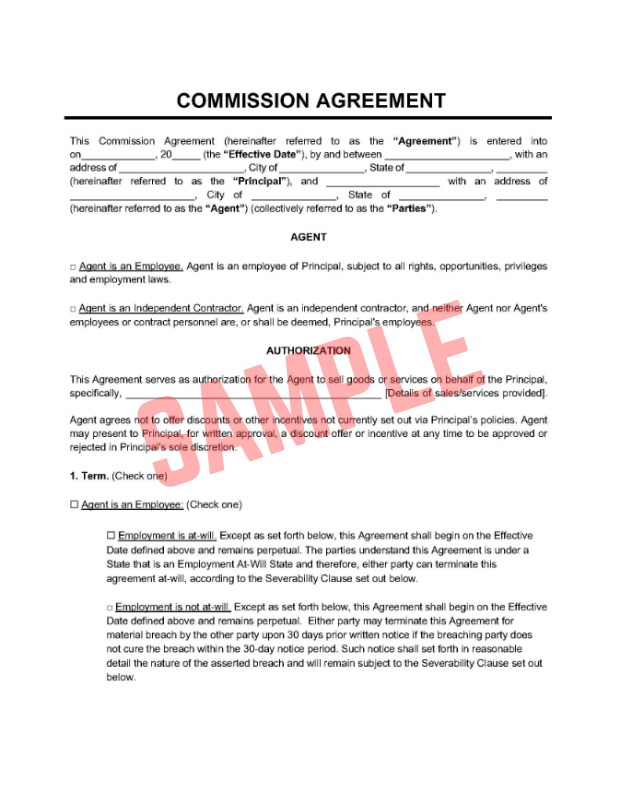
Sample Commission Only Employment Contract Template
Below is a simplified **commission only employment contract template** example. This format is designed to illustrate the key sections you should include. Remember, this is a sample and should be customized with legal counsel for your specific needs and jurisdiction.
COMMISSION ONLY EMPLOYMENT AGREEMENT
This Commission Only Employment Agreement (“Agreement”) is made effective as of [Date], by and between:
[Company Legal Name] (“Company”), a [State of Incorporation] corporation, with its principal place of business at [Company Address],
AND
[Employee Full Name] (“Employee”), residing at [Employee Residential Address].
1. Employment Position
The Company hereby employs the Employee in the position of [Job Title, e.g., Sales Representative]. The Employee agrees to perform the duties typically associated with this role, as well as other duties as reasonably assigned by the Company. This is an “at-will” employment relationship, subject to the terms herein.
2. Compensation Structure
The Employee’s compensation shall be solely commission-based, without a fixed salary. Commissions will be calculated as follows:
- Commission Rate: [Specify percentage, e.g., 10%] of the net revenue generated from sales of [Product/Service Name] directly attributed to the Employee.
- Definition of Net Revenue: Net revenue is defined as the gross amount received by the Company for a sale, less any discounts, refunds, or sales taxes.
- Eligibility: Commissions are earned only upon full payment received by the Company from the customer for the sale.
- Payment Schedule: Commissions will be calculated and paid [e.g., monthly] on the [e.g., 15th] day of the following calendar month, for all eligible sales paid in full during the previous month.
- Chargebacks: In the event of customer refunds or chargebacks for sales on which commissions have already been paid, the Company reserves the right to deduct such commission amounts from future commission payments to the Employee.
3. Employee Responsibilities
The Employee agrees to:
- Actively solicit and secure new customers for the Company’s [Product/Service].
- Maintain a professional demeanor and represent the Company positively.
- Adhere to all Company policies and procedures.
- Provide regular sales reports and updates as required.
4. Territory
The Employee shall primarily operate within the sales territory of [Specify Territory, e.g., “State of California” or “no specific territory”].
5. Independent Contractor vs. Employee Status
It is expressly understood and agreed that the Employee is an employee of the Company for all purposes, including federal and state tax and labor laws, and not an independent contractor. The Company shall withhold applicable taxes from commission payments.
6. Termination of Employment
Either party may terminate this Agreement at any time, with or without cause, by providing [e.g., 14 days’] written notice to the other party.
- Commissions Upon Termination: Upon termination, the Employee will be paid all commissions earned (i.e., sales fully paid by the customer) up to the effective date of termination, in accordance with the regular payment schedule.
- No Severance: No severance pay will be provided upon termination.
7. Confidentiality and Non-Solicitation
The Employee agrees to keep all proprietary and confidential information of the Company strictly confidential. The Employee further agrees not to solicit the Company’s clients or employees for a period of [e.g., 12 months] following the termination of employment.
8. Governing Law
This Agreement shall be governed by and construed in accordance with the laws of the State of [Specify State], without regard to its conflict of laws principles.
9. Entire Agreement
This Agreement constitutes the entire agreement between the parties concerning the subject matter hereof and supersedes all prior agreements, understandings, negotiations, and discussions, whether oral or written.
IN WITNESS WHEREOF, the parties hereto have executed this Agreement as of the date first written above.
_____________________________
[Company Legal Name] (Employer)
_____________________________
[Employee Full Name] (Employee)
Employing a commission-only structure can significantly benefit your business, but only with the right legal framework in place. A comprehensive **commission only employment contract template** is not just a formality; it’s a vital tool for clarity, protection, and sustained success. By meticulously defining compensation, responsibilities, and termination conditions, you establish a solid foundation for productive relationships.
Remember that legal requirements vary by jurisdiction, so this sample should serve as a starting point. Always consult with a qualified legal professional to tailor your commission agreement to your specific business needs and local laws. Investing in a robust contract today can save you from significant legal challenges and foster a more confident, motivated sales team in the future.