Navigating legal disputes can feel overwhelming, especially when faced with an unresolved issue that impacts your rights or finances. Before resorting to formal litigation, a critical first step often involves sending a clear, formal communication to the opposing party. This initial communication can set the stage for resolution and potentially prevent a lengthy court battle.
Understanding how to properly initiate this process is crucial for anyone considering legal action. A well-drafted document, such as a notice of intent to sue, serves as a formal warning, outlining your grievances and demanding specific action. This article will guide you through the intricacies of this important legal document, including how to use a robust notice of intent to sue template to protect your interests effectively.
Here, we will explore the purpose behind sending such a notice, delve into its essential components, and provide a practical sample to help you understand its structure. By the end, you’ll have a clear understanding of why and how to use this powerful tool in your legal strategy.
Understanding The Purpose Of A Notice Of Intent To Sue
A notice of intent to sue is far more than just a formal letter; it’s a strategic communication designed to achieve resolution outside of court. It serves as a pre-litigation tool, signaling your serious intent to pursue legal remedies if your demands are not met. This formal notice can be a powerful catalyst for negotiation and settlement, saving both parties time and expense.
Many jurisdictions or specific types of disputes, such as those involving government entities or certain consumer protection laws, may even legally require sending a notice before filing a lawsuit. For instance, in some cases, a claimant must provide formal notice within a specific timeframe after an incident, like a personal injury, before they can initiate a civil lawsuit. Failing to do so can jeopardize your ability to file a claim later.
Why Send A Formal Notice Before Litigation?
Sending a formal notice before initiating a lawsuit offers several distinct advantages. Primarily, it opens a channel for dialogue and potential settlement, allowing both parties to resolve the dispute without the costs and stress associated with litigation. Around 95% of civil cases in the United States are settled or dismissed before trial, underscoring the importance of early resolution attempts.
Secondly, it clearly articulates your position, the damages incurred, and the specific relief you seek. This clarity can prompt the other party to take your claims seriously and consider their options. A well-crafted letter can demonstrate that you have a strong understanding of your legal rights and are prepared to defend them.
Key Situations Requiring A Pre-Lawsuit Letter
A pre-lawsuit letter, often structured as a notice of intent to sue template, is applicable in numerous scenarios where you seek redress for a wrong. Understanding when to deploy this tool is vital for an effective legal strategy.
- Personal Injury Claims: After an accident, notifying the at-fault party or their insurance company of your intent to seek compensation for medical bills, lost wages, and pain and suffering is a common practice.
- Breach of Contract: If a party fails to uphold their obligations under an agreement, a formal notice can demand performance or compensation for damages resulting from the breach.
- Landlord-Tenant Disputes: Issues like unreturned security deposits, failure to make repairs, or illegal eviction notices often warrant a formal letter before escalating to housing court.
- Consumer Complaints: For defective products, unfair business practices, or service issues where direct communication has failed, a notice can signal a serious intent to pursue legal action.
- Debt Collection Issues: If you believe a debt collector is violating your rights under consumer protection laws, a notice can demand compliance and threaten legal action for non-compliance.
In each of these situations, the notice serves as a foundational step, providing a final opportunity for resolution before formal legal proceedings begin. It establishes a clear timeline and makes your intentions unambiguous.
Crafting Your Notice Of Intent To Sue Template Effectively
Creating an effective notice of intent to sue involves more than just stating your intention to sue; it requires careful attention to detail and a clear presentation of facts. The goal is to make your case compelling and leave no doubt about the severity of the situation. Precision in language and organization is key to its impact.
Using a structured approach, like adapting a reliable notice of intent to sue template, ensures you include all necessary legal and practical elements. This reduces the risk of overlooking critical information that could weaken your position or delay resolution. Remember, this document may later be presented as evidence if the case proceeds to court.
Essential Components Of A Strong Demand Letter
A powerful demand letter, acting as your notice of intent to sue, must be comprehensive and unambiguous. Each section plays a vital role in conveying your message and establishing the credibility of your claim. Carefully include the following components:
- Sender and Recipient Information: Clearly list your full name and contact information, along with the full name and contact details of the party you intend to sue.
- Date: The date the letter is sent is crucial for establishing timelines, especially if a deadline for response is included.
- Subject Line: A concise and clear subject line, such as “Notice of Intent to Sue Regarding [Brief Description of Dispute],” immediately informs the recipient of the letter’s purpose.
- Statement of Intent: Explicitly state that this letter serves as a formal notice of your intent to pursue legal action if a satisfactory resolution is not reached.
- Factual Background of the Dispute: Provide a detailed, chronological account of the events leading to the dispute. Include specific dates, times, locations, and involved parties. Attach supporting documents as exhibits.
- Legal Basis for the Claim: Briefly explain why you believe the other party is legally responsible for your damages. Reference specific laws, contract clauses, or legal principles if possible.
- Specific Demands/Requested Relief: Clearly state what you expect the other party to do to resolve the matter. This could be a monetary payment, specific performance, property return, or other actions. Specify the exact amount if demanding money.
- Deadline for Response: Set a reasonable timeframe (e.g., 10-30 days) for the recipient to respond to your demands before you proceed with filing a lawsuit.
- Consequence of Non-Compliance: Reiterate that failure to meet the demands by the deadline will result in the immediate filing of a lawsuit without further notice.
- Reservation of Rights: Include a statement that you reserve all other rights and remedies available to you under the law.
- Signature: Sign the letter with your full name.
Each of these elements contributes to the overall strength and legal weight of your notice, demonstrating your preparedness to take decisive action.
Tips For Delivery And Documentation
Sending your notice of intent to sue template correctly is just as important as drafting it. Proper delivery ensures the other party receives the letter and provides you with proof of delivery, which can be critical if the matter proceeds to court.
Always send the letter via certified mail with a return receipt requested. This provides undeniable evidence that the letter was sent and received, and by whom. Additionally, keep a complete copy of the signed letter and all attached exhibits for your records. Consider sending a duplicate copy via regular mail as well, as a backup measure.
Documenting every step, including the date of mailing, the tracking number, and the return receipt, creates a robust paper trail. This meticulous record-keeping strengthens your position and can be invaluable if you need to demonstrate that you attempted to resolve the dispute before litigation.
Sample Notice Of Intent To Sue Template
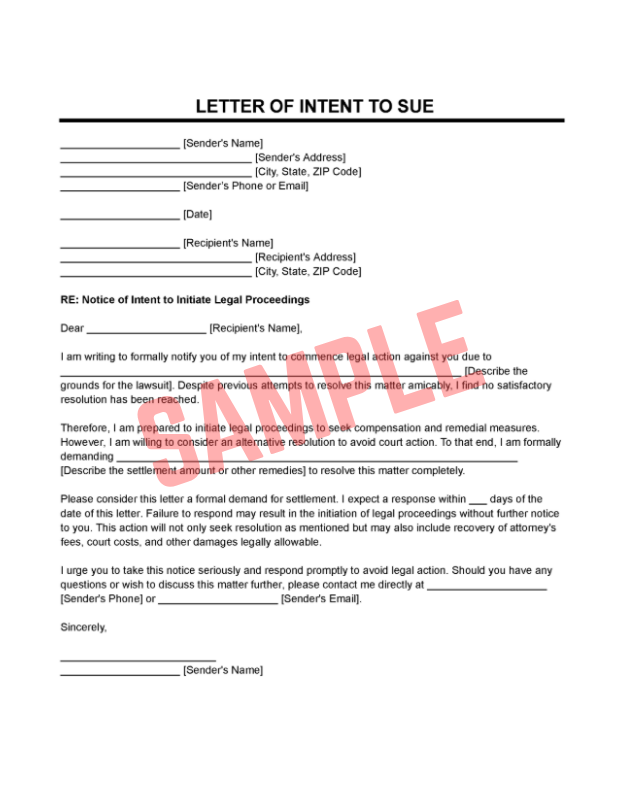
Using a well-structured sample can significantly streamline the process of drafting your own notice of intent to sue. This template provides a comprehensive framework that you can adapt to your specific situation, ensuring all essential elements are included. Remember to replace the bracketed information with your personal details and specific case facts.
Below is a general notice of intent to sue template that covers common scenarios. Always consider consulting with an attorney to tailor this document precisely to your legal needs and jurisdiction.
[Your Full Name]
[Your Address]
[Your City, State, Zip Code]
[Your Phone Number]
[Your Email Address]

[Date]

[Recipient's Full Name/Company Name]
[Recipient's Address]
[Recipient's City, State, Zip Code]

Subject: Formal Notice of Intent to Sue Regarding [Briefly State the Nature of the Dispute, e.g., Breach of Contract, Personal Injury Claim, Unreturned Security Deposit]

Dear [Mr./Ms./Mx. Last Name of Recipient or To Whom It May Concern],

This letter serves as a formal and unequivocal notice of my intent to file a civil lawsuit against you/your company, [Recipient's Name/Company Name], in a court of law if a satisfactory resolution to the dispute described herein is not reached within thirty (30) days from the date of this letter.

The basis for this notice arises from the following facts:

[Provide a clear, concise, and chronological account of the events. Use separate paragraphs for distinct points. Include specific dates, locations, and names of individuals involved. For example:]

1. On or about [Date], I, [Your Name], entered into a written contract with [Recipient's Name/Company Name] for [describe service or product]. A copy of this contract is attached hereto as Exhibit A.
2. Under the terms of the contract, you/your company were obligated to [state specific obligation].
3. On [Date], you/your company failed to [describe how the recipient breached the contract, e.g., "deliver the product as agreed," "complete the work by the deadline," "pay the outstanding invoice"]. This failure constitutes a material breach of the agreement.
4. As a direct result of this breach, I have suffered damages, including but not limited to [itemize damages, e.g., "financial losses totaling $X," "significant delays and additional costs of $Y to hire another contractor," "emotional distress and medical expenses"]. Documentation supporting these damages is attached hereto as Exhibit B.

[Alternatively, for a personal injury claim:]

1. On [Date] at approximately [Time], at [Location], I was involved in an incident where [Recipient's Name/Company Name]'s negligence directly caused [describe the incident, e.g., "a traffic collision," "a slip and fall"].
2. As a direct and proximate result of this incident, I sustained severe personal injuries, including [list injuries, e.g., "a broken arm," "whiplash," "concussion"], requiring extensive medical treatment and resulting in lost wages.
3. Your negligence, specifically [describe negligent act, e.g., "running a red light," "failing to maintain safe premises"], is the cause of these damages. Supporting documentation such as police reports, medical records, and bills are attached as Exhibit C.

To resolve this matter and avoid litigation, I demand the following specific action within the aforementioned thirty (30) day period:

[Clearly state your demand(s). For example:]

1. Immediate payment of [Specific Dollar Amount] to compensate for the damages incurred.
2. [Any other specific action, e.g., "Completion of the contracted work according to the original terms," "Return of property"].

Please understand that this offer to settle is made in an attempt to avoid the costs and time associated with court proceedings. If I do not receive a satisfactory response addressing my demands by [Date – 30 days from letter date], I will proceed immediately with filing a lawsuit against you/your company without further notice. This lawsuit will seek full compensation for all damages, plus any applicable legal fees, court costs, and interest as allowed by law.

I reserve all my rights and remedies under the law.

Sincerely,

[Your Signature]

[Your Typed Full Name]
This comprehensive notice of intent to sue template provides a solid foundation. Ensure you adapt every section to reflect the unique details of your dispute. Attach all relevant supporting documents as exhibits and reference them clearly within the letter for maximum impact.
In conclusion, a notice of intent to sue is a powerful and often necessary step in resolving legal disputes before they escalate to court. By formally articulating your grievances, clearly stating your demands, and setting a firm deadline, you create a structured path toward potential settlement. This pre-litigation document not only demonstrates your seriousness but also provides the opposing party with a final opportunity to address the issue, potentially saving everyone involved significant time, money, and stress.
While a comprehensive notice of intent to sue template can guide you, the specifics of legal action can be complex and vary greatly by jurisdiction and the nature of the dispute. Therefore, it is always highly recommended to consult with a qualified attorney. A legal professional can review your situation, ensure your notice adheres to all legal requirements, and advise on the best course of action to protect your rights and achieve a favorable outcome.